
 Liviu Marcus
What is ECU Remapping?
ECU remapping has become one of the most popular methods for optimizing vehicle performance in recent years. However, there are still many misconceptions about it. Some believe that remapping can fix any issue from turning off the check engine light to repairing mechanical engine or transmission failures. Others think it is only a tool for increasing engine power.
In reality, ECU remapping is an engineering-based software optimization process for the engine management system, not a substitute for mechanical repairs. When performed correctly by a skilled specialist, it can improve engine performance, refine factory limitations, and in specific cases resolve software related calibration issues. However, using remapping to Delete and ignore mechanical faults or suppress error codes does (DTCs) not solve the underlying issue and may lead to severe engine damage.
At Ninja Remap, all ECU modifications are performed based on the vehicle’s mechanical health, usage type, and engineering standards. We never use remapping to conceal engine faults or disable critical control systems improperly, and mechanical repair is always prioritized over software-based masking.
Below, we analyze which modifications are fully legitimate through ECU remapping, which are conditionally recommended, and which should never be done via software.
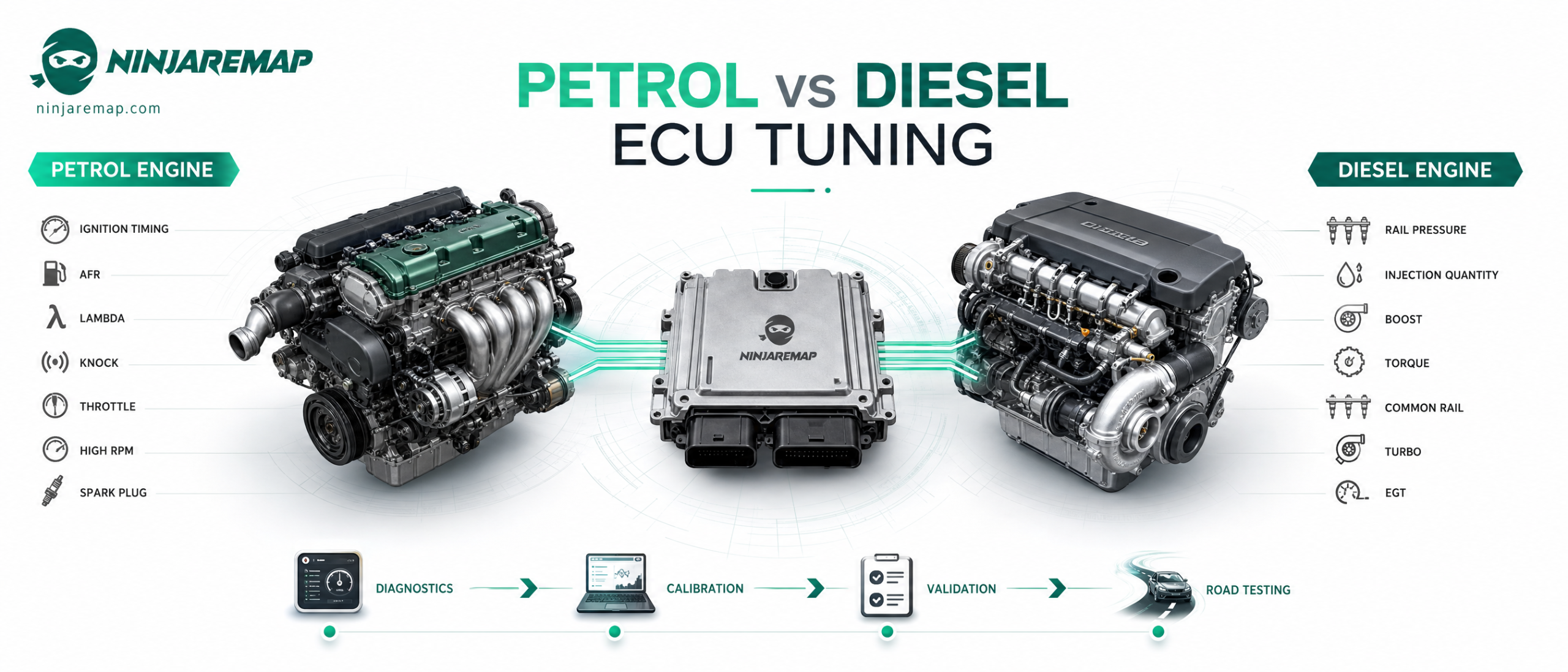
Petrol Engine ECU Remapping:
What Can Be Improved with Petrol ECU Tuning?
- Performance Remap (engine performance optimization)
- Solution Remap (software corrections and calibration adjustments)
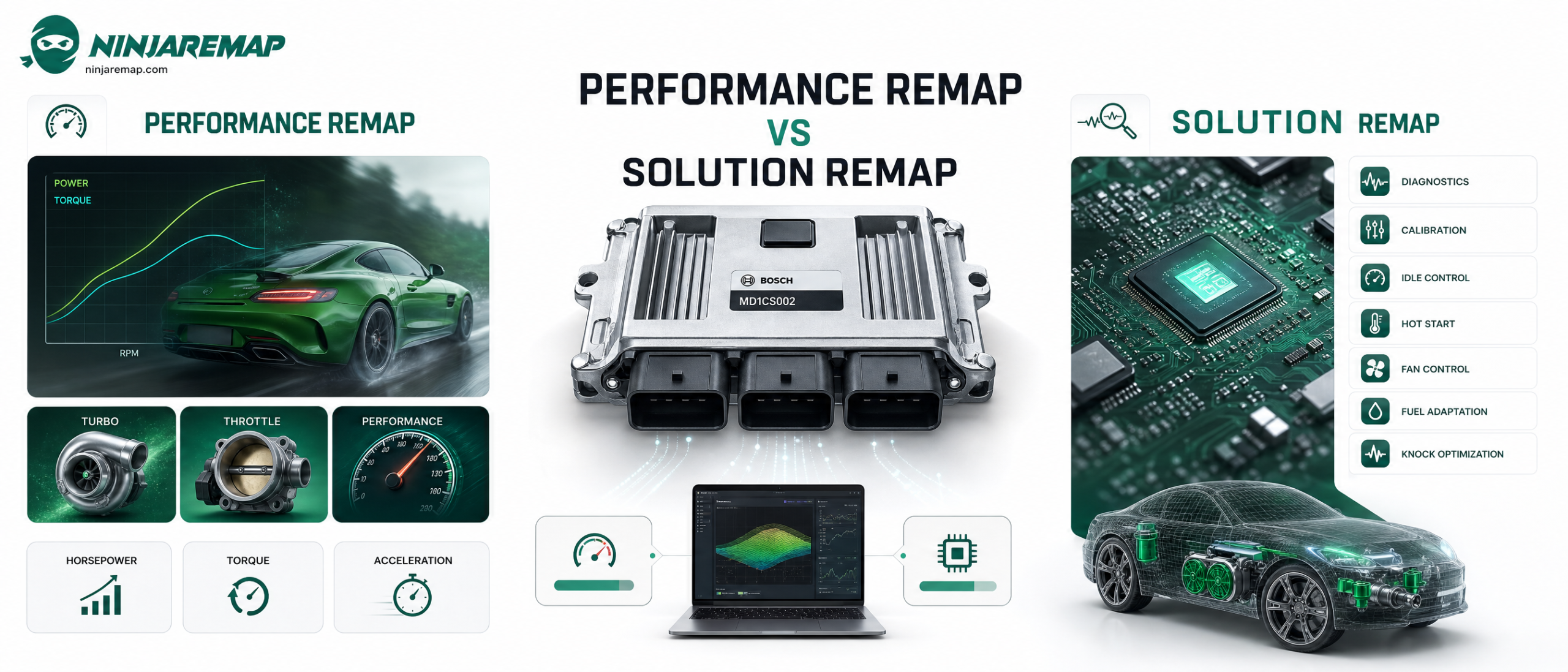
Performance Remap (Gasoline Engines)
The goal of performance remapping is to extract the engine’s real potential without significantly reducing reliability or lifespan. This involves recalibrating key engine maps such as ignition timing, fuel delivery, torque limits, throttle response, boost control, and torque-based strategies.
Engine Power Increase
Manufacturers often calibrate engines with significant safety margins due to fuel quality differences, emissions regulations, climate variations, and marketing strategies.
With proper ECU tuning, these restrictions can be optimized, allowing increased output (Power & Torque) without excessive stress on the engine components like piston or conrods. The level of gain depends on the engine type (naturally aspirated or turbocharged) and its mechanical potential.
Torque Optimization
In real-world driving or daily driving, torque improvement is often more important than horsepower increase. By optimizing torque maps and tune fuel and ignition strategies, the engine delivers better low end and mid-range performance, improving acceleration from standstill, hill climbs, and take off.
Acceleration Improvement
A refined torque curve and improved engine responsiveness reduce acceleration time. In turbocharged engines, optimizing boost pressure and torque management plays a key role in improving overall performance of new ECUs like Bosch or Continental.
Throttle Response Enhancement
Modern vehicles often use electronically controlled throttle systems with conservative calibration to reduce fuel consumption, emissions and drivability. This creates a delay between pedal and engine response.
Proper calibration reduces this lag or delay, resulting in a more responsive and natural driving feel without necessarily increasing peak engine power. However, excessive sensitivity tuning is not recommended as it can negatively affect drivability and fuel economy.
Turbocharged Engine Optimization
In turbocharged engines, boost pressure control, torque management, and turbo efficiency can be optimized. This reduces turbo lag and delivers smoother, more consistent power across a wider RPM range.
Rev Limiter Adjustment
In performance projects where internal engine components have been upgraded, increasing the rev limiter may be possible for wider RPM power. This should only be done if engine internals such as pistons, rods, and valve springs can handle higher RPMs.
Uncontrolled Rev limiter increases (Remove RPM Limiter or Open cut off) without mechanical reinforcement can lead to severe engine damage.
Speed Limiter Removal
Many vehicles come with factory-imposed speed limitations. These can be removed or adjusted depending on usage conditions and safety considerations.
Fuel Consumption Optimization
Contrary to common belief, remapping does not always increase fuel consumption. Under similar driving behavior, fuel usage may remain stable or even slightly decrease. However, frequent use of increased performance naturally leads to higher consumption.
Knock Correction (Knock Fix)
Engine knock or preignition is one of the most dangerous combustion phenomena in gasoline engines, typically caused by low fuel quality, high engine temperatures, or incorrect ignition timing or Bad spark plug.
Persistent knock can damage pistons, rings, bearings, and valves.
Through optimized ignition timing, fuel mapping, and thermal management strategies, knock occurrence can be significantly reduced or solved. This is known as a fuel adaptive calibration strategy, primarily aimed at improving engine safety and durability rather than performance.
Idle Speed Optimization
Some vehicles, especially three cylinder engines, use very low idle RPM, which can cause vibration, instability, noise, and reduced oil pressure.
If the engine is mechanically healthy, slightly increasing idle speed improves smoothness and stability.
Cooling Fan Temperature Adjustment
In hot climates or modified engines (stage2 or 3 tuning), lowering fan activation temperature can help reduce heat soak and stabilize engine temperature.
If the cooling system is in good condition, fan activation thresholds can typically be reduced by 3–5°C. However, excessive cooling strategy modifications may negatively impact efficiency and fuel consumption.
ACT Cylinder Deactivation Disable (VAG Engines)
Some Volkswagen Group engines use ACT (Active Cylinder Technology), which deactivates two cylinders under low load to improve fuel economy.
Some drivers experience slight vibration during cylinder activation/deactivation transitions. Disabling ACT via ECU calibration can provide smoother operation, though it may slightly increase fuel consumption in city driving.
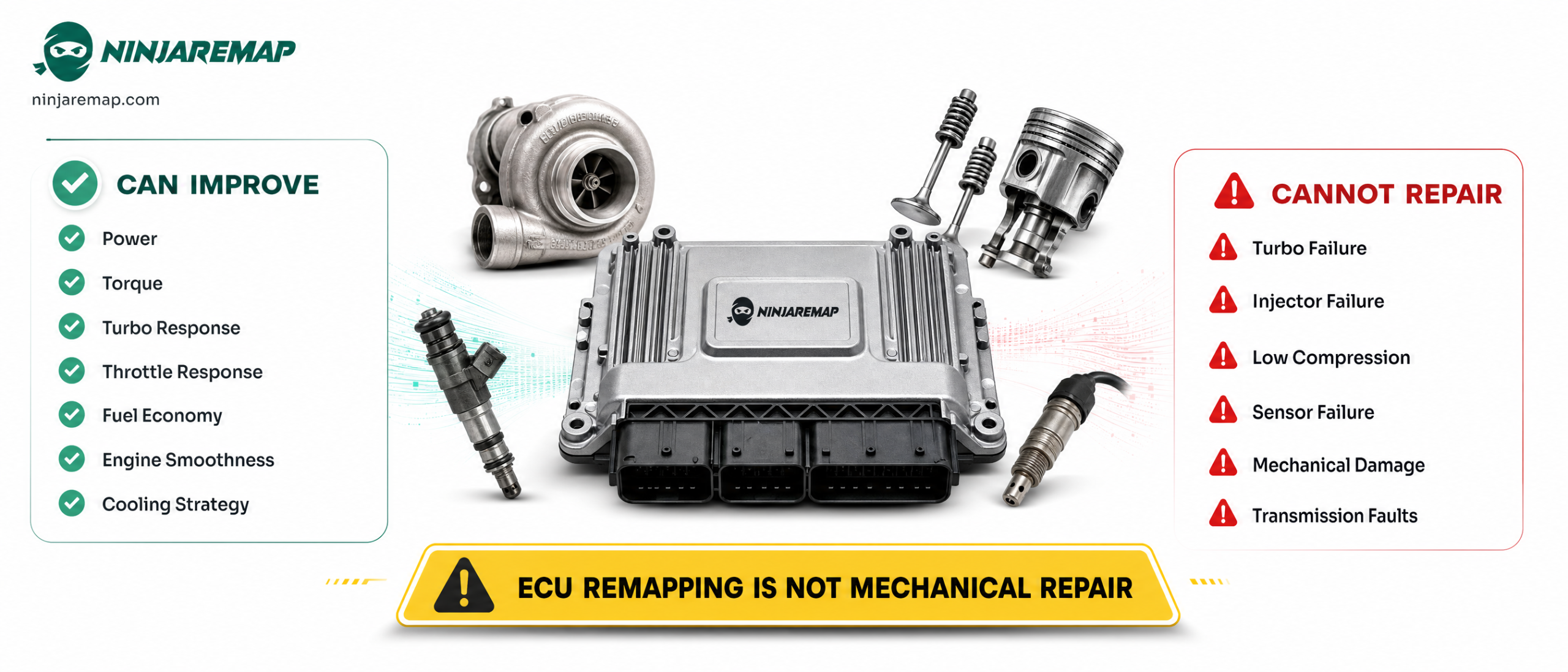
What Cannot Be Fixed with Petrol ECU Tuning?
Many issues cannot be solved through software alone, as they originate from mechanical faults. The following examples represent common issues that require proper diagnosis and mechanical repair rather than software intervention.
VVT Fault Codes
Failures in Variable Valve timing systems, oil control valves (OCV), oil pressure issues, or mechanical timing problems can cause power loss, increased fuel consumption, rough idle, and poor engine performance and function.
Suppressing error codes (DTC OFF) only hides the Check Engine light and does not fix the root cause. Proper mechanical diagnosis and repair are required.
Oxygen Sensor (Upstream O2 Sensor)
The upstream oxygen sensor is critical for air fuel ratio (Lambda) control. Failure leads to bad fuel economy, reduced performance, and increased emissions.
Deleting error codes does not restore sensor functionality and may damage the engine or catalytic converter over time.
Downstream Oxygen Sensor
The downstream oxygen sensor monitors catalytic converter efficiency rather than AFR control.
In vehicles with modified exhaust systems (headers, downpipes, or removed catalytic converters), disabling downstream O2 monitoring may be acceptable, provided the mechanical modifications have already been completed.
Misfire Faults
Misfire issues are usually caused by faulty spark plugs, ignition coils, injectors, fuel delivery issues, or mechanical compression problems.
Removing these fault codes does not solve the issue and continued driving may cause catalytic converter damage or engine failure.
🟦 Gasoline ECU Remap – Simplified Table
| Remap | Technical Review |
| Performance Remap | Optimizes ignition timing, fuel delivery, throttle mapping, and torque limits to improve responsiveness, acceleration, and drivability within safe factory margins. |
| Solution Remap | Adjusts ECU calibration to improve drivability issues such as throttle lag, idle stability, knock sensitivity, and minor calibration inefficiencies without addressing mechanical faults. |
| DTC Delete | Cannot resolve mechanical problems such as misfires, VVT faults, injector failures, or sensor malfunctions; these require physical repair. |
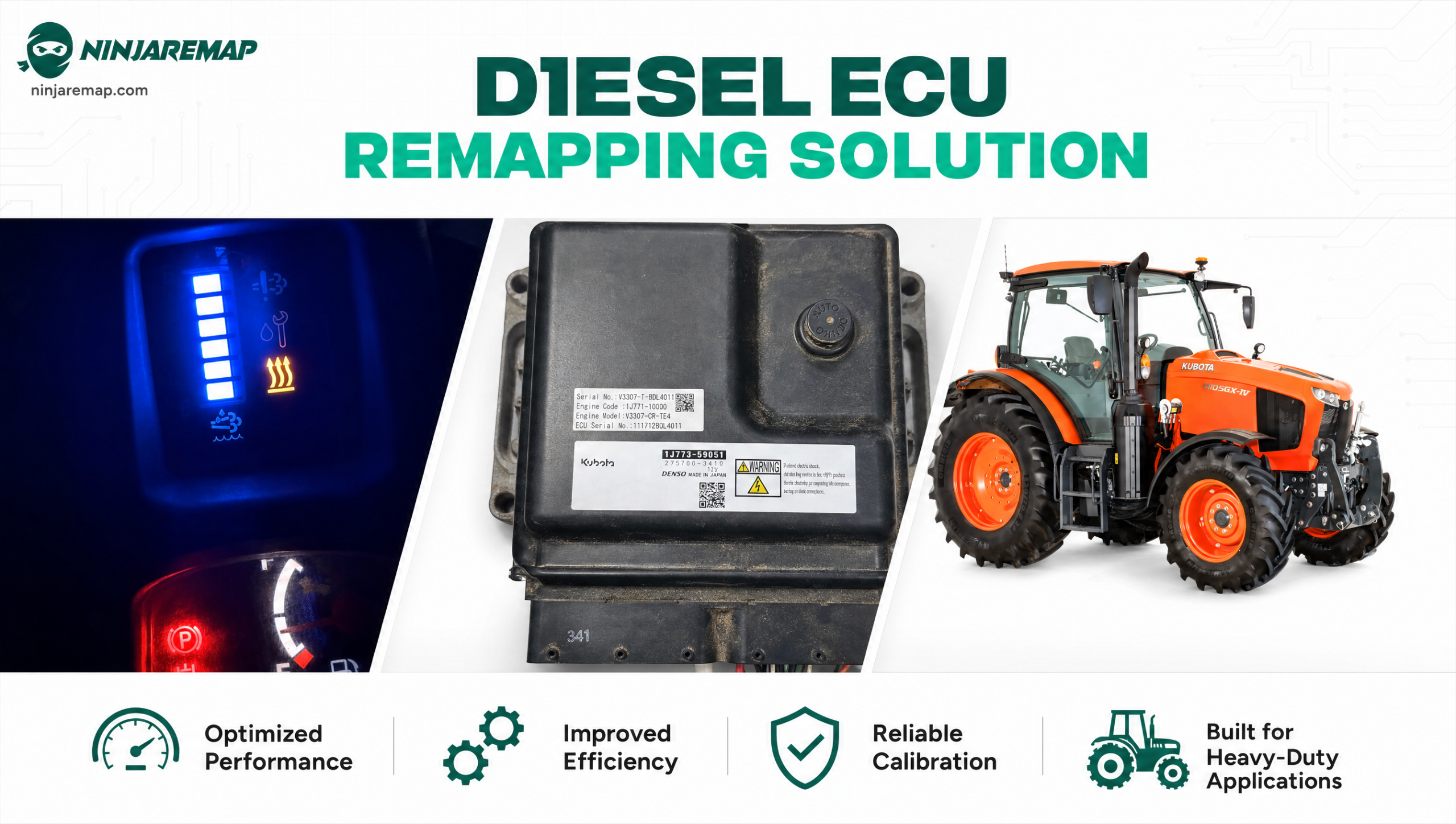
Diesel Engine ECU Remapping:
What Can Be Improved with Diesel ECU Tuning?
- Performance Remap (engine performance optimization)
- Solution Remap (software corrections and ECU behavior improvements)
Performance Remap (Diesel Engines)
The goal of diesel performance remapping is to improve combustion efficiency, increase torque output, and better engine’s full potential without compromising reliability.
Torque Increase
The most significant advantage of diesel remapping is the noticeable increase in torque. By optimizing fuel injection maps (Injection Time, Timing, pressure), rail pressure, boost pressure, and torque management strategies, the engine delivers significantly stronger low end and mid-range performance.
This improvement is especially noticeable during towing, carrying heavy loads, or driving in mountainous terrain.
Engine Power Increase
In many diesel engines, manufacturers do not utilize the full potential of the engine due to emissions regulations, fuel quality variations, and durability considerations.
With proper ECU calibration, it is possible to increase power output without placing excessive stress on engine components, provided that tuning is done within safe mechanical limits.
Turbo Lag Reduction
Many diesel vehicles suffer from noticeable turbo lag during initial acceleration. By optimizing boost control strategies and turbo management maps, this delay can be significantly reduced, allowing the engine to reach peak torque more quickly.
Acceleration Improvement
A smoother torque curve combined with improved turbocharger control and optimized driver wish maps results in faster and more linear acceleration across all gears.
Boost Pressure Optimization
Boost pressure must always be calibrated according to turbocharger capability and safety, exhaust gas temperature (EGT), and fuel system limitations.
Excessive or uncontrolled boost increase does not necessarily improve performance and can significantly reduce turbocharger and engine lifespan.
Fuel Consumption Optimization
In normal driving conditions, many diesel engines may achieve similar or even lower fuel consumption after a proper remap. This is because the engine requires less throttle input to generate the same level of torque.
However, frequent use of increased performance will naturally result in higher fuel consumption.
Solution Remap (Diesel Engines)
This section focuses not on power gains, but on resolving software-related issues or adapting ECU behavior for specific use cases.
Hot Start Fix
Some diesel vehicles, especially certain Volkswagen Group (VAG) models, may experience hard starting when the engine is warm, while cold starts remain normal.
In many cases, this issue is not caused by faulty components but by factory calibration strategies. Specifically, it is often related to the Start Injection Quantity map.
By recalibrating the ECU, the engine can start smoothly in warm conditions as well, eliminating delayed hot starts without hardware replacement.
Start/Stop Deactivation
The Start/Stop system is designed to reduce fuel consumption and emissions by shutting off the engine during idle periods.
However, many drivers find frequent engine shutdown and restart behavior uncomfortable. If requested, this system can be disabled via ECU calibration, so the engine remains running in traffic conditions.
DTC Delete (Diagnostic Trouble Code Management)
In certain cases, removing specific fault codes becomes necessary after mechanical modifications or system deletion.
However, fault code removal is only considered valid when the root cause is fully understood and addressed. Using DTC delete to hide mechanical issues is not a professional or acceptable solution.
Swirl Flap Delete
Swirl flaps are used in many diesel engines to improve airflow, enhance low-end torque, and reduce emissions.
In some engines particularly certain BMW models swirl flap failure can lead to severe engine damage. Because of this risk, they are sometimes removed mechanically and corresponding ECU adjustments are applied.
While this modification can prevent catastrophic failures, it may slightly reduce low-end torque and increase emissions. Proper ECU calibration can partially compensate for this loss.
TVA Delete
In some diesel engines, the throttle valve actuator (TVA) can be disabled in software after mechanical removal. This modification must only be performed when the system has been properly and completely removed from the vehicle.
DPF Off
The Diesel Particulate Filter (DPF) is designed to capture soot particles from exhaust gases and reduce emissions.
In off-road vehicles, motorsport applications, or vehicles used outside public roads, the DPF is sometimes removed mechanically. In such cases, ECU recalibration is required to disable regeneration cycles and associated fault codes.
DPF removal should only be performed for non-road-use vehicles, such as off-road or competition setups.
EGR Off
The Exhaust Gas Recirculation (EGR) system reduces NOx emissions by redirecting a portion of exhaust gases back into the combustion chamber.
In some specialized Tuning, after mechanical removal of the EGR system, ECU calibration is required to disable its operation.
EGR removal is generally intended only for off-road, motorsport, or non-public-road applications due to increased emissions.
SCR Off (AdBlue System)
The SCR system uses AdBlue fluid to reduce NOx emissions in diesel engines.
In specific cases where the system is completely removed for off-road or racing use, ECU calibration must also be adjusted accordingly.
SCR deletion is strictly intended for non-road-use vehicles and is not recommended for vehicles operated on public roads.
What Cannot Be Fixed with Diesel ECU Tuning?
One of the most common misconceptions about ECU tuning is using it to hide mechanical faults. In many cases, deleting fault codes only turns off the Check light while the underlying issue remains unresolved. The following examples represent common issues that require proper diagnosis and mechanical repair rather than software intervention.
Injector Fault Deletion
In Common Rail diesel engines, injectors operate under extremely high pressure and play a critical role in combustion quality. Injector failure can cause rough idle, hard starting, power loss, increased fuel consumption, smoke, or abnormal engine noise.
Internal injector leakage may also contaminate engine oil with diesel fuel, reducing lubrication quality and increasing engine wear.
Deleting injector fault codes does not resolve these issues. Proper injector testing, correction value analysis, repair, or replacement is required.
Rail Pressure Sensor Fault
Fuel rail pressure is one of the most critical parameters in diesel engine operation. Any deviation caused by sensor failure, high-pressure pump issues, or leaks can result in poor starting, power loss, limp mode activation, or excessive smoke.
Suppressing this fault only hides the warning, while the engine continues operating under incorrect fuel pressure conditions, potentially damaging injectors and the high-pressure pump (HPFP).
Turbocharger Fault Deletion
The turbocharger is one of the most critical and expensive components in diesel engines.
Failures in the actuator, vacuum system, variable geometry mechanism (VGT), leaks, or internal damage can cause power loss, noise, smoke, or limp mode.
Ignoring these issues by deleting fault codes can lead to severe damage to turbine blades and engine components. Proper mechanical diagnosis is essential.
NOx Sensor Fault
The NOx sensor is part of the SCR system and measures nitrogen oxide levels in exhaust gases.
If SCR is active, deleting NOx sensor faults is not a proper solution and only suppresses system warnings. Repair or replacement is the correct approach.
ECU Remapping Is Not a Substitute for Engine Repair
No software solution can replace mechanical repair. If an engine suffers from low compression, turbo failure, injector wear, fuel system issues, or transmission problems, remapping will not fix the root cause and may even accelerate component failure.
A professional tuning process always begins with a full mechanical inspection of the vehicle. Only after confirming that the engine is in good condition can ECU calibration deliver optimal and safe results.
🟨 Diesel ECU Remap – Simplified Table
| Category | Technical Review |
| Performance Remap | Enhances injection timing, rail pressure, boost control, and torque management to significantly increase low-end torque, towing capability, and overall drivability. |
| Solution Remap | Refines ECU behavior to fix calibration-related issues such as hot start problems, throttle response inconsistencies, and system-driven drivability limitations. |
| Limitations | Cannot fix hardware issues such as injector faults, turbo failure, rail pressure problems, or clogged DPF systems; mechanical repair is required. |
Conclusion
ECU remapping is one of the most effective methods for optimizing diesel engine performance when performed correctly and based on engineering principles.
Proper tuning can improve torque, power delivery, throttle response, fuel efficiency, and driving comfort. However, using software modifications to hide mechanical issues is fundamentally incorrect and may lead to costly failures.
| Remap Type Purpose Recommended Performance Increase power and torque ✅ Solution Resolve calibration-related issues ✅ Fault Delete Suppress mechanical problems ❌ | |
At Ninja Remap, our philosophy is based on accurate diagnostics, engine safety, and engineering-driven calibration. Every vehicle is carefully evaluated before tuning, and only modifications that are safe, logical, and suitable for the vehicle’s condition are applied.
Professional remapping is not just about increasing power it is about balancing performance, reliability, efficiency, and driving enjoyment.
Author Bio
Ninja Remap specializes in professional ECU calibration, performance tuning, and advanced engine management solutions for petrol and diesel vehicles. Our engineering approach focuses on reliable performance, safe calibration, and data-driven optimization.


GIPHY App Key not set. Please check settings